
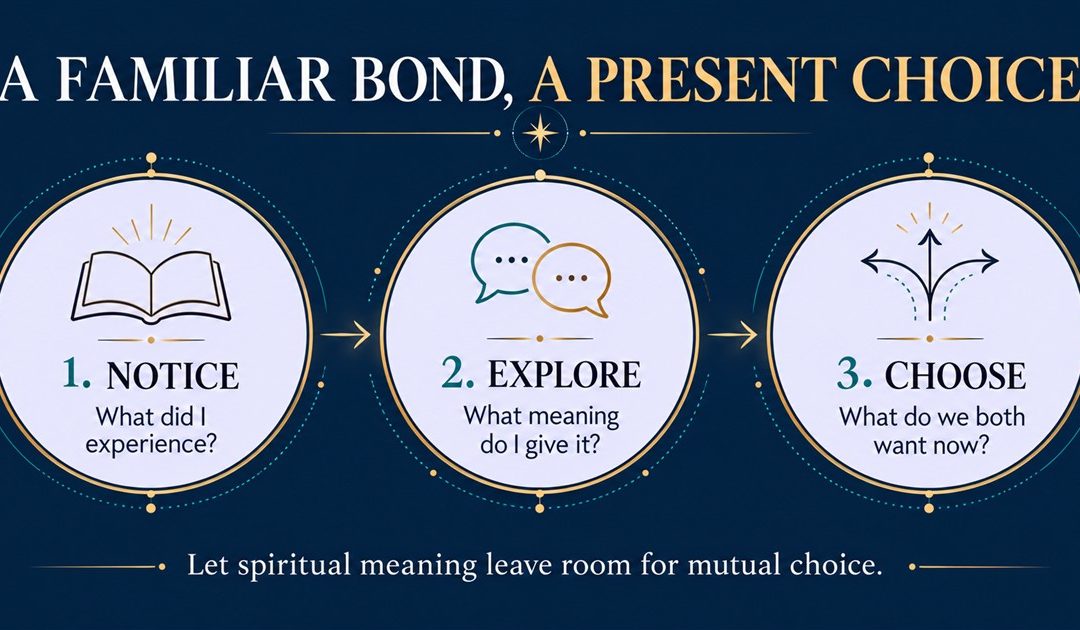
A new person can feel strangely familiar: a conversation flows, a place stirs an emotion or a shared detail seems unusually moving. If you believe in reincarnation, you may wonder whether a soulmate from another life has returned. That possibility can hold personal meaning while you continue to discover who the person is today.
You do not need to decide the history of two souls before choosing your next step. The most useful question is how the connection fits both people’s present lives, wishes and boundaries.
What does a past-life soulmate mean to you?
Some spiritual accounts describe souls meeting across lifetimes, sometimes as partners and sometimes through friendship or family. Others understand the same feeling through memory, imagination, attraction or a shared background. There is no agreed test that confirms a particular former-life relationship.
A meaningful interpretation is different from a verified biography. Population growth does not establish how reincarnation works or prove that people you meet have known you before. A sense of recognition can remain a question rather than becoming an obligation.
Notice the experience before naming its cause
Familiarity
Describe what felt familiar: a voice, gesture, interest or way of speaking. Ask what you already knew and what is still new.
A powerful emotion
Notice joy, longing, grief or calm without assigning the feeling to the other person. Your experience does not reveal their private memories or consent.
A repeated image
Record the image and when it appeared. Include recent reading, films, conversations or expectations that might have influenced it.
A coincidence
A shared date or recurring song can become a personal symbol. It cannot verify a past marriage, a promise or a future reunion.
The person in front of you has a present life
Even within a reincarnation belief, it is helpful to recognize this person’s current identity, culture, commitments and wishes. You may imagine an old connection while they feel a new friendship, or no particular connection. Let their own account matter.
A useful invitation might be “I enjoyed talking with you. Would you like to meet for coffee?” It leaves room for an answer. “Our souls are already together” can feel like pressure if it assumes a relationship the other person has not chosen.
For a wider reflection on intense bonds, see connecting with a twin flame or soulmate. A spiritual description can support empathy without replacing direct communication.
Places, dreams and memories: keep the source visible
A landscape, historic building or place of worship can evoke strong images. You may explore that meaning without treating travel as a way to activate a hidden identity. There is no requirement to visit a famous “energy” destination or spend money to unlock your past.
Respect the rules, access limits and religious significance of any place you visit. Sacred sites belong to living communities and traditions, not a universal memory-recovery itinerary. An unfamiliar feeling does not establish that a cultural identity is yours to claim.
If you record a dream, call it a dream. If imagery arises in meditation or a reading, preserve that context. The University of Virginia’s Division of Perceptual Studies explains its concerns about hypnotic regression; vivid imagery is not a reliable shortcut to verifying a past-life history. You do not need regression to reflect on a relationship.
Old-story emotions do not create a debt
You might feel drawn to themes of reunion, betrayal, rescue or unfinished love. Ask what those themes bring up in your present life. They can suggest a question about trust or loss without proving that someone wronged you centuries ago.
Do not confront another person as though an imagined scene establishes guilt. You can work with a story as a private metaphor while judging current behavior separately. Our guide to karmic relationship language and responsibility explores how to keep accountability specific.
Growth can include staying, changing or leaving
A challenging relationship may prompt learning, but harm is not a gift you must accept. You do not have to prove spiritual maturity by tolerating fear, control or repeated boundary violations. Nor must every difficult conversation mean the relationship should end.
Look at the issue itself. Do both people want to address it? Can each person say no? Does an apology connect with a change? The love is respect boundary guide offers practical ways to name needs. Seek appropriate support when safety or coercion is involved.
Free past-life meaning and present-choice worksheet
Use this for your own reflection. You do not need another person to agree with the spiritual story.
- Experience: What happened, in plain language?
- Source: Was it a dream, impression, conversation or known fact?
- Meaning: What possible theme matters to me?
- Present reality: What has the other person actually said or chosen?
- Next step: What is respectful, proportionate and within my control?
Example: “A dream about a reunion → dream imagery → I miss companionship → my former partner has asked for no contact → I will honor that boundary and arrange time with a friend.”
Let a connection matter without making it permanent
You may keep a tender memory, change your interpretation or decide the label no longer fits. A relationship can be important without continuing in the same form. Closure need not require a reading, another meeting or agreement about a past life.
Be cautious if someone guarantees a reunion, assigns you a romantic debt or asks for repeated payments to clear a supposed curse. No reading can establish another person’s consent. If you want help preparing useful questions, see questions to bring to a psychic reading.
You can carry spiritual meaning into a present-day choice: listen carefully, ask rather than assume, and leave room for the other person’s freedom alongside your own.
Frequently asked questions
1. What is a past-life soulmate?
It is a spiritual interpretation of a meaningful bond as continuing across lifetimes. There is no agreed test confirming a specific former-life relationship.
2. Does instant familiarity prove we met before?
No. Familiarity may matter to you while having several possible explanations.
3. Can a soulmate be a friend or relative?
Some people use the term for romantic, family or friendship bonds. Definitions vary.
4. Does population growth prove reincarnation?
No. Population figures do not establish a mechanism for returning souls or identify past-life connections.
5. Do I need to travel to a sacred site?
No. You do not need a special destination or paid journey to explore personal meaning.
6. Can a dream identify a former partner?
A dream can inspire reflection but does not establish another person’s historical identity or private memories.
7. Is hypnotic regression necessary?
No. It is not required for reflection, and vivid imagery does not verify a history.
8. Should I confront someone about a remembered betrayal?
Do not treat imagery as proof of wrongdoing. Discuss current behavior using facts and appropriate support.
9. Do we owe each other a relationship?
No. A spiritual story does not create consent, access or a romantic debt.
10. What if the other person does not share my belief?
Respect their account. A different interpretation does not make them less awakened or obliged to agree.
11. Does pain show the bond is important?
Pain does not establish destiny or make harm a duty to endure.
12. Can I leave a meaningful relationship?
Yes. You can acknowledge meaning and still choose distance or an ending.
13. How should I use the worksheet?
Separate the experience, its source, possible meaning, present facts and a respectful next step.
14. Can a reader guarantee a reunion?
No. Be cautious of guarantees, curse claims and escalating payments.
15. Can I move forward without solving the past-life question?
Yes. Present consent, behavior and your own needs can guide a choice while the spiritual interpretation remains open.